
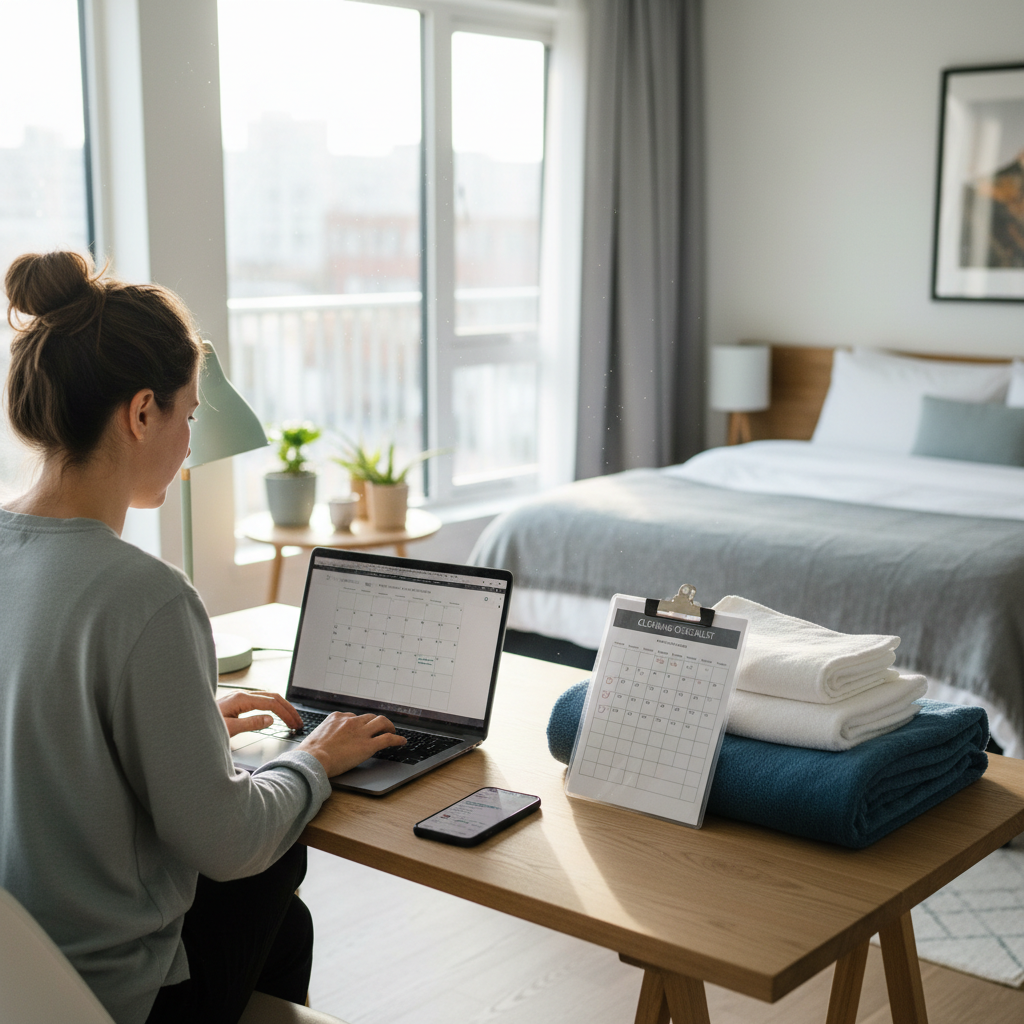
It's the question every new host asks, and the honest answer is more nuanced than the listings make it sound. Running a successful Airbnb isn't complicated in the way that fixing a boiler or drawing up a lease is - none of the individual tasks are hard to understand. What makes it hard is that there are a lot of tasks, they never really stop, and several of them have to happen at inconvenient times of day. This guide is an honest, no-spin look at what self-managing an Airbnb actually involves: the real hours, the real jobs, and the points at which most hosts decide it's worth handing it over to someone else.
The honest answer
Managing one well-presented property in a decent location, with a reliable cleaner and a calm temperament, is genuinely manageable. Plenty of hosts do it around a full-time job. Managing two or three properties, or doing the cleaning yourself, or operating in a city with heavy event demand, is a different proposition entirely - it quickly becomes a part-time job of its own.
So the difficulty isn't a fixed thing. It scales with the number of properties, how hands-on you want to be, how much you value your evenings and weekends, and how well you've systemised the repetitive work. The rest of this guide breaks those factors down so you can judge where you'd sit on that curve.
The real time commitment
Ask most hosts how long it takes and you'll get a shrug. The truth is that the work comes in bursts - a quiet week might need three or four hours, a changeover week with a tricky guest and a maintenance issue can swallow fifteen. Averaged across a year, a self-managed host typically spends around 8-12 hours per week per property. Here's where that time goes:
| Task | Hours per week | When it tends to happen |
|---|---|---|
| Guest communication | 3-5 hrs | Evenings, weekends, whenever a message arrives |
| Cleaning & changeovers | 2-4 hrs | Between 10am check-out and 3-4pm check-in |
| Pricing & calendar management | 1-2 hrs | Weekly, plus ad-hoc adjustments |
| Maintenance & repairs | 1-3 hrs | Unpredictable - often urgent |
| Admin, compliance & finances | 1-2 hrs | Monthly, but easy to let slide |
The figure that surprises new hosts most is guest communication. Three to five hours a week doesn't sound like much, but it's spread across the whole week in fragments - a quick reply at 9pm, a check-in message on a Sunday morning, a mid-stay question at lunchtime. It's the cognitive load of being 'on call' as much as the raw hours that wears people down.
And it scales faster than you'd think. A second property doesn't quite double the work, but it does double the points of failure - two calendars to sync, two sets of guests messaging, two changeovers to coordinate. Most self-managers find three properties is the practical ceiling before something starts to slip.
The five jobs you actually do
Strip away the romance of 'being a host' and you're really doing five jobs, often badly and all at once. Understanding each one helps you see where your time - and your stress - is really going.
Guest communication - answering enquiries, sending check-in details, handling in-stay questions and writing reviews.
Cleaning and changeovers - coordinating (or doing) the turnover between guests within a tight 4-5 hour window.
Pricing and calendar management - setting nightly rates, adjusting to demand, keeping dates open and synced across platforms.
Maintenance and emergencies - fixing issues guests report and dealing with the 11pm 'the boiler's stopped' call.
Admin and compliance - insurance, safety certificates, tax, accounts and platform updates.
Let's look at what each one really involves day to day.
Guest communication: the job that never switches off
This is the part most new hosts underestimate, and it's the part that makes people give up. Every guest journey is a chain of messages - the initial enquiry, the booking confirmation, the pre-arrival instructions, the 'how do I work the heating?' at 10pm, the review request after check-out. Miss any of them or reply slowly, and your response-rate metric slips, your search ranking drops, and the next booking gets harder.
Airbnb's algorithm rewards hosts who reply within an hour. In practice that means keeping the app on your phone, checking it in the cinema, replying on holiday, and never quite switching off. For a single property it's manageable; for a guest with a tricky check-in at the same time as you're at a family dinner, it's a genuine source of friction.
Cleaning and changeovers
The changeover window is the tightest part of the whole operation. Guests check out around 10-11am, the next guests arrive from 3-4pm. In that window the property needs a full clean, fresh linen, restocked consumables, a quick maintenance check, and a tidy-up. Do it yourself and it's a physical, time-boxed job you can't skip; hire a cleaner and you're managing a person whose schedule has to align with your bookings.
The trap here is reliability. A great cleaner is worth their weight in gold; a flaky one is a recurring crisis. Many self-managers end up doing the clean themselves 'just this once' more often than they'd admit, because finding cover at short notice is harder than just doing it.
Pricing and calendar management
Set your nightly rate once and leave it, and you're guaranteed to lose money - too high in the slow weeks (empty nights), too low in the busy weeks (income you never captured). Good pricing means reviewing rates regularly, watching local events, adjusting for weekends and seasons, and keeping your calendar genuinely open and synced across every platform you list on.
Done properly this is an hour or two a week of focused work. Done badly it's the difference between a property that earns £25,000 a year and one that earns £35,000 - for essentially the same amount of effort everywhere else.
Maintenance and emergencies
This is the unpredictable part. A leak under the sink, a washing machine that won't drain, a lock that jams while a guest is standing outside in the rain - these can't be scheduled, and they often arrive at the worst possible time. Self-managing means keeping a list of reliable tradespeople, being able to authorise spending without phoning around for three quotes, and occasionally dropping everything to sort a problem yourself.
Properties managed professionally tend to have lower long-term maintenance costs for a simple reason: every changeover is an inspection, so small issues are caught in 48 hours rather than six months later when they've become expensive.
Admin, compliance and paperwork
The boring jobs are the ones that bite you if you ignore them. Gas safety certificates, an EICR, smoke and carbon monoxide alarms, an EPC rated E or above, specialist short-let insurance, and accounts that make sense at tax time. None of this is hard, but it all has deadlines, and the penalties for getting it wrong - from invalidated insurance to local authority action - are disproportionate to the effort of staying on top of it.
What makes it genuinely hard
No single task is difficult. The difficulty lives in the combination of all of them, plus a few things that don't show up on any to-do list:
It's a 24/7 job - guests message at all hours, and 'I'll reply in the morning' costs you response-rate points.
There's no cover for holidays - go away for a week and someone still has to manage check-ins, cleanings and emergencies.
Bad guests and bad reviews sting - one party or one unfair 3-star review can take months to recover from.
It doesn't scale cleanly - a second and third property add more than linear complexity.
The money bits are invisible - pricing, fees and deductions are easy to get wrong and hard to audit.
It competes with your real life - the changeover clashing with your child's birthday is the moment many hosts start looking at management companies.
Self-managed vs professionally managed
Once you tot up the hours and the stress, the question becomes whether doing it yourself is actually worth it. Here's how the two models compare for a typical single property:
| Self-managed | Professionally managed | |
|---|---|---|
| Weekly time | 8-12 hours | 1-2 hours (reviewing statements) |
| Guest communication | You, 24/7 | A team, 24/7 |
| Cleaning | You or your cleaner | Vetted local teams |
| Pricing | Manual or basic tool | Dynamic, adjusted daily |
| Maintenance cover | Your tradespeople, your time | Coordinated, often 24/7 |
| Typical fee | 0% | 12-15% + VAT |
| Net income (2-bed city) | Slightly higher per booking | Often higher overall once pricing & occupancy are optimised |
"I genuinely loved it for the first year. By the second property I was missing family dinners to do changeovers. Handing it over was the best decision I made - I still earn more, I just don't have to be the one cleaning at 1pm on a Saturday."
- Tom H, landlord who self-managed then switched to Truestays
The net-income line is the one to sit with. A good management company takes a fee, but dynamic pricing and higher occupancy often recover more than the fee costs - meaning many landlords earn similar or more, with a fraction of the effort.
When self-managing makes sense
Self-managing isn't the wrong choice - for the right person it's rewarding and profitable. It tends to work when:
You have one property and live nearby.
You enjoy the hosting side and don't mind the 24/7 nature.
You have flexible work or control over your own diary.
You have a reliable cleaner you trust completely.
You're comfortable with the pricing, compliance and admin.
You value maximum per-booking income over your own time.
When it's worth handing it over
Conversely, professional management tends to pay for itself - in money, time, or both - when:
You have two or more properties, or one property and a busy life.
You travel or can't reliably cover check-ins and emergencies.
You don't live close enough to get there quickly.
You'd rather not manage guests, cleaners and tradespeople.
You want dynamic pricing and multi-platform distribution done properly.
You value predictable, hands-off income over squeezing every last pound.
How to make self-managing easier
If you're going to self-manage, the goal is to turn the repetitive jobs into systems so you're left doing only the things that genuinely need you. The biggest wins:
Automate the messages - templated, triggered replies for enquiries, confirmations, check-in instructions and review requests save hours every week.
Lock down a great cleaner - a reliable cleaner is the single biggest determinant of whether you enjoy hosting or resent it.
Switch on dynamic pricing - even a basic pricing tool beats a static rate, and recovers the cost within a few bookings.
Go keyless - a smart lock or lockbox removes the single most common check-in headache.
List on more than one platform via a channel manager - Airbnb, Booking.com and Vrbo through one synced calendar adds bookings without adding double-booking risk.
Build a welcome guide - a single, well-written guide answers 80% of in-stay questions before they're asked.
Keep finances separate - a dedicated account and simple tracking software makes tax time painless.
Do all of the above and a single property can genuinely run on a few focused hours a week. Skip them and you'll spend those hours instead firefighting.
Frequently asked questions
How many hours a week does an Airbnb take?
For a single, well-run property, expect 8-12 hours a week averaged across the year - more during busy periods and changeovers, less in quiet weeks. The work comes in bursts and isn't confined to working hours, which is as much the challenge as the total hours.
Is managing an Airbnb harder than a long-let?
It's more hands-on, but in a different way. A long-let is low-effort day-to-day but carries higher-stakes risks - arrears, voids, and a slow, expensive repossession process if things go wrong. A short-let needs steady attention but every booking is pre-paid, guests leave on a set date, and the property is inspected every few days, so issues surface fast. Most hosts find short-lets more work but lower stress.
Can I manage an Airbnb with a full-time job?
Yes - many people do, for a single property. The key is automation: templated messages, a reliable cleaner, a smart lock and a channel-managed calendar. Where it breaks down is emergencies and cover when you're away, which is usually the point people either partner with a friend or hand over to a management company.
How much does a management company cost?
Full-service management typically costs 12-15% + VAT of booking revenue. Cleaning is usually charged per stay (£80-£150 depending on size). For most landlords, the combination of dynamic pricing and higher occupancy recovers more than the fee - so the net income is often similar to self-managing, with a fraction of the time commitment.
Key takeaways
Self-managing one property takes roughly 8-12 hours a week, in bursts across evenings and weekends.
The real challenge isn't difficulty - it's volume: five jobs that never stop and often happen at inconvenient times.
Guest communication and the changeover window are the two parts that wear hosts down fastest.
Static pricing is the biggest income leak; dynamic pricing is the biggest single fix.
A second and third property add more than linear complexity - three is the practical self-managed ceiling.
Good management companies often recover their fee through better pricing and occupancy, leaving net income similar but effort a fraction.
If you enjoy hosting, live nearby and have one property, self-managing works. If not, handing it over usually pays for itself.
Ready to get started?
Get a free personalised income estimate for your property. No commitment, no pressure.