
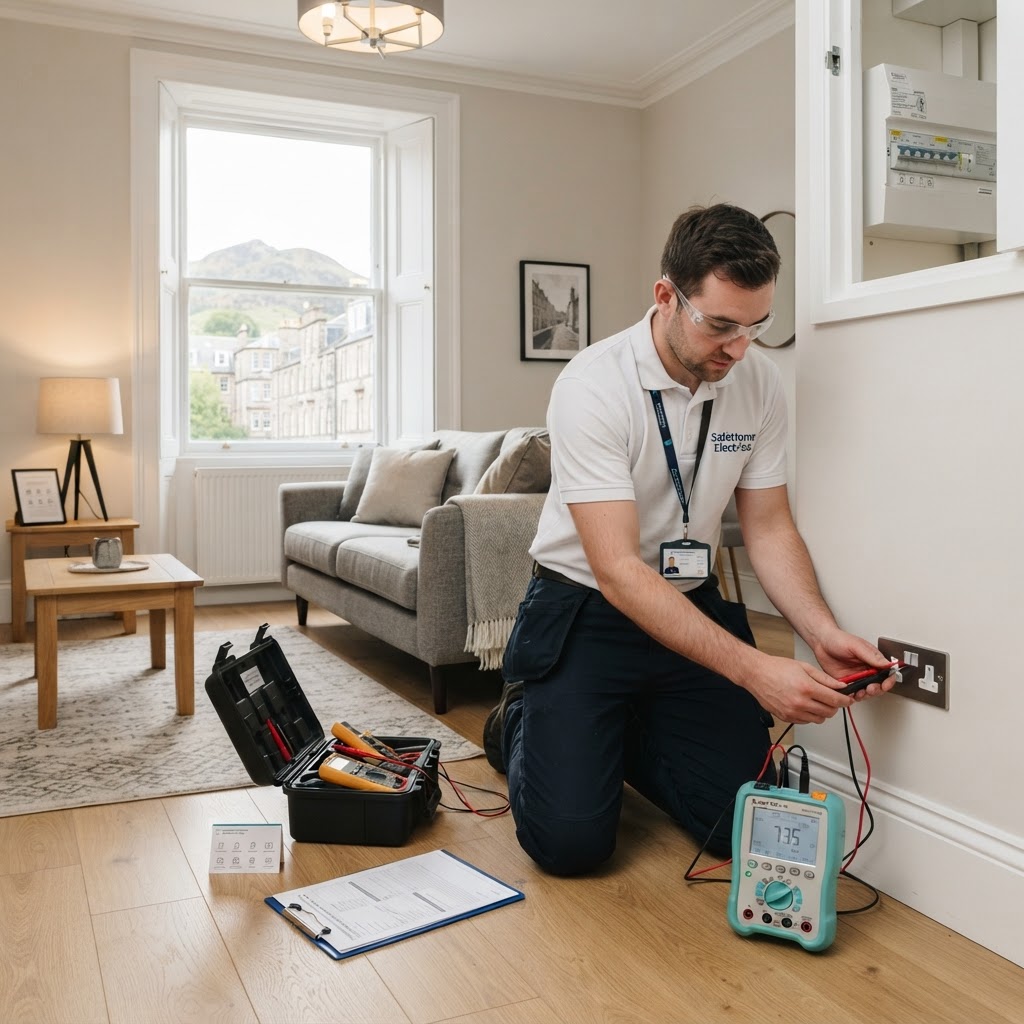
Electrical safety is one of the areas where short-let landlords most frequently make assumptions they cannot afford to make. The rules differ from long-term tenancy law in ways that catch operators out, and the consequences of getting it wrong range from significant fines to personal liability if a guest is injured.
Why electrical safety matters for short-let landlords
Between 2018 and 2023, the UK government's own data recorded approximately 14,000 accidental dwelling fires per year where the source was electrical. Guests in short-let properties are, by definition, unfamiliar with the building, its wiring and its appliances. They cannot flag a buzzing socket or a tripping fuse board the way a long-term tenant might, because by the time they notice a problem, they have already used the property for half their stay. That asymmetry of knowledge places a greater duty of care on the operator, not a lesser one.
The practical stakes are also commercial. A single serious electrical incident at one of your properties does not just affect that listing. It surfaces in reviews, it triggers platform investigations, and depending on how your insurance policy is written, a failure to hold current safety documentation can void a claim entirely. Operators managing portfolios in cities like Manchester, Leeds and Birmingham have seen exactly this happen when a claim was disputed because no valid EICR was on file.
What the Electrical Safety Standards in the Private Rented Sector Regulations 2020 actually cover
The Electrical Safety Standards in the Private Rented Sector (England) Regulations 2020 came into force for new tenancies from 1 July 2020 and for all existing tenancies from 1 April 2021. They require landlords to ensure that the electrical installations in a rented property are inspected and tested at intervals of no more than five years by a qualified person, and that an Electrical Installation Condition Report (EICR) is produced. Landlords must supply a copy of that report to tenants before they occupy the property, and to any prospective tenant within 28 days of a written request.
The regulations define the standard against which installations are assessed as the 18th Edition of the IET Wiring Regulations (BS 7671). An EICR will classify defects as C1 (danger present, requiring immediate action), C2 (potentially dangerous, urgent remedial work needed), C3 (improvement recommended) or FI (further investigation required). A C1 or C2 result means the installation is unsatisfactory and remedial work must be completed within 28 days, or sooner if the report specifies it. A C3 result does not constitute a failure but should be taken seriously given the duty of care to guests.
Do the 2020 Regulations apply to short-let properties?
This is where the law requires careful reading. The 2020 Regulations apply to 'specified tenancies', which the legislation defines as a tenancy of residential premises in England. A typical Airbnb or short-let booking is a licence, not a tenancy, because the guest does not have exclusive possession of the property in the legal sense. On that strict reading, the 2020 Regulations do not technically mandate EICRs for short-let operators in the way they do for assured shorthold tenancy landlords.
However, stopping the analysis there would be a serious mistake. Short-let properties that operate as a business, accept paying guests and are advertised to the public fall under a separate and arguably more demanding framework. Properties classified as Houses in Multiple Occupation (HMOs) have their own mandatory electrical inspection requirements under the Housing Act 2004. Beyond that, local licensing schemes in cities such as Bristol, Nottingham and parts of London impose their own conditions that frequently include valid EICR documentation as a licence condition. If your property falls under any selective or additional licensing scheme, you need an EICR regardless of the tenancy question.
More broadly, every short-let operator has a common law duty of care to guests. If a guest suffers injury from a faulty installation and you cannot demonstrate that the wiring was inspected and certified within a reasonable period, no court or insurer will take kindly to the argument that the 2020 Regulations technically did not apply. The absence of a regulatory mandate does not remove the duty; it simply changes the enforcement mechanism from a local authority fixed penalty to a civil claim. Most experienced operators treat an in-date EICR as non-negotiable for any property that charges paying guests, whatever its legal classification.
For operators in Scotland, the position is clearer: the Housing (Scotland) Act 2014 and the associated Repairing Standard include an explicit requirement for electrical installations to meet the standard, and Electrical Installation Condition Reports are expected as evidence of compliance for all private lets, including short-term lets that hold a short-term let licence under the Civic Government (Scotland) Act 1982 (Licensing of Short-Term Lets) Order 2022.
EICR inspections: what they involve and what they cost
An EICR is carried out by a registered electrician, typically one registered with NICEIC, ELECSA or a similar competent person scheme. The inspector examines the consumer unit (fuse board), checks that circuits are correctly protected, tests earthing and bonding, identifies any deterioration and verifies that the installation meets BS 7671. For a typical two-bedroom flat the inspection takes between two and four hours. For a larger detached property with multiple circuits, expect closer to a full day.
In terms of cost, operators in Northern England typically pay between £150 and £250 for a two-bedroom flat, rising to £300 to £450 for a four or five-bedroom house. London rates are roughly 20 to 30 per cent higher. Any remedial work required to achieve a satisfactory result is charged separately and can range from a straightforward consumer unit replacement at around £500 to more significant rewiring work on older properties, particularly Victorian terraces in cities like Liverpool, Sheffield and Bristol, where the original wiring may date from the 1970s or earlier.
The five-year cycle is a maximum interval, not a target. If you have had significant electrical work carried out, if the property has experienced flood or fire damage, or if your electrician recommends an earlier reinspection, act on that advice. Some operators in high-turnover city-centre serviced apartment buildings commission an informal electrical check annually alongside their gas safety inspection simply to keep documentation current and catch issues before they escalate.
PAT testing: when it is required and when it is not
Portable Appliance Testing (PAT) is widely misunderstood. There is no law in England, Wales or Scotland that specifically mandates annual PAT testing for residential short-let properties. The obligation comes from the general duty under the Electricity at Work Regulations 1989 to ensure that electrical equipment is maintained in a safe condition. PAT testing is one way to demonstrate compliance with that duty, but it is not the only way and it is not legally prescribed at any specific interval.
In practice, most short-let operators PAT test portable appliances every one to two years. The cost is modest: typically £1 to £3 per item for a standard visit, meaning a fully equipped two-bedroom flat might cost £60 to £120 to cover all appliances. What matters more than the frequency is the record-keeping. If an appliance fails and causes injury, the question an insurer or court will ask is not 'did you PAT test annually' but 'did you take reasonable steps to ensure that appliance was safe'. A test register showing items were checked, tagged and any failing items removed or replaced is strong evidence of reasonable steps.
One nuance worth flagging: if you supply a property with brand new appliances, those appliances arrive with CE or UKCA marking confirming they meet product safety standards. A new toaster does not need to be PAT tested on day one. The testing obligation becomes relevant as appliances age, are used heavily by guests, or show signs of damage. Build a simple appliance log noting the purchase date and condition of each item and review it at every changeover deep clean.
What happens if you fail to comply
For properties where the 2020 Regulations do apply, local authorities can issue a remedial notice requiring compliance within 28 days. If a landlord fails to act, the local authority can arrange the work itself and recover costs. Financial penalties of up to £30,000 can be issued per breach. In Scotland, a short-term let licence can be refused or revoked where electrical safety obligations are not met, effectively shutting down the operation.
Beyond the regulatory enforcement, the insurance angle is the one that affects operators most directly. Read your short-let insurance policy carefully. Most reputable policies written specifically for serviced accommodation and Airbnb properties include a condition that the property must hold valid safety certificates and comply with applicable regulations. An insurer defending a claim will check whether your EICR was in date. If it was not, they have grounds to dispute the claim, and that dispute will cost you time, legal fees and potentially the full value of a claim that might otherwise have been settled quickly.
If you manage properties across multiple cities or are considering expanding your portfolio, staying on top of electrical compliance at scale is one of the operational challenges that often gets harder before it gets easier. Truestays manages short-let properties across the UK and handles compliance documentation as part of day-to-day operations. If you want to understand what your property could earn with full compliance in place, get a free income estimate from Truestays and we will walk you through what we cover.
This article provides general guidance only and should not be treated as legal or professional advice. Electrical safety obligations vary depending on property type, location and applicable licensing conditions. You should consult a qualified electrician and, where relevant, a solicitor or compliance specialist for advice specific to your property.
Ready to get started?
Get a free personalised income estimate for your property. No commitment, no pressure.