
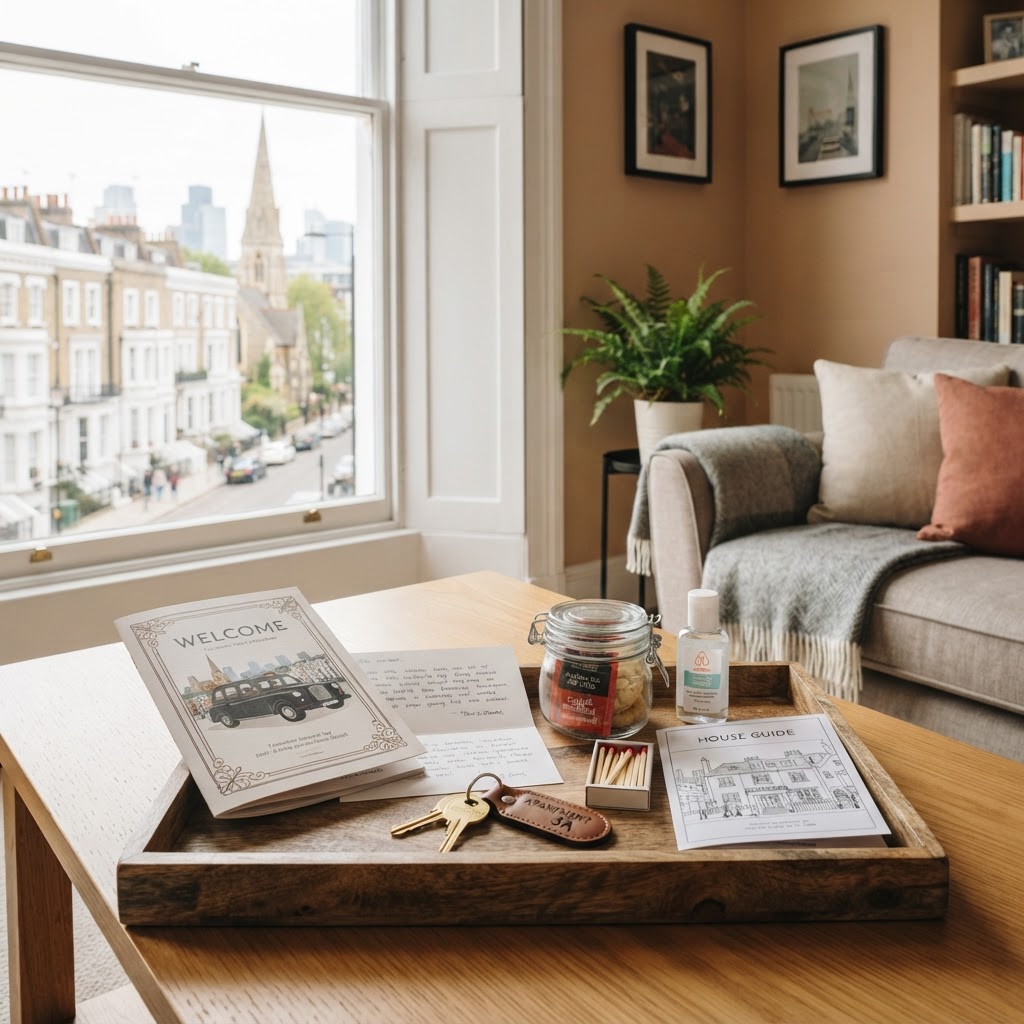
Most guest complaints and bad reviews trace back to a single cause: the guest did not know what to expect. A welcome pack does not just answer questions — it sets the tone for the entire stay and removes friction before it starts. Get it right and your message volume drops, your reviews improve and you rarely hear from guests until checkout.
Why a welcome pack actually affects your reviews
Airbnb's review algorithm rewards the quality of the guest experience, and a significant part of that experience is whether the guest felt informed and looked after from the moment they arrived. When guests have to message you to ask for the WiFi password, where the spare towels are, or how the heating works, that friction registers — even if they do not mention it in the review itself. What shows up instead is a three or four star on 'communication' despite you responding within minutes, simply because the information was not available at arrival.
From managing properties across cities including Leeds, Manchester and Birmingham, the pattern is consistent: listings with a thorough welcome pack receive around 30 to 40 percent fewer mid-stay messages than those without one. That is not a guess — it is something you can measure yourself after three months of hosting by comparing your message threads.
What to include in the physical or digital pack
There are two formats worth considering: a printed welcome pack left in the property, and a digital guide sent before arrival. The best setups use both. The digital version (sent 24 to 48 hours before check-in via Airbnb's messaging system) lets guests orient themselves before they arrive. The physical version is what they reach for at 11pm when they cannot find the extra blankets.
The core information every pack needs to cover falls into a few clear categories. Start with access: exact check-in instructions, the key safe or lockbox code (changed per booking), parking details including any permit requirements or paid zones nearby, and how to contact you in a genuine emergency. Then move to the property itself: WiFi name and password displayed prominently, how the heating and hot water work (especially combi boilers, which confuse guests repeatedly), which bins are which and what day they go out, and where to find additional linen, towels and cleaning supplies.
Check-in instructions with any access codes and parking details
WiFi name and password
Heating, hot water and appliance instructions
Bin days and recycling guidance
Emergency contact number for genuine issues
Checkout procedure including key return and what to leave on or off
The checkout section deserves more attention than most hosts give it. Be specific: ask guests to strip the beds, leave used towels in the bath, put the dishwasher on, close all windows, and leave the keys in the lockbox. Properties that spell this out clearly get handed back in better condition. Properties that just say 'please leave tidy' get interpreted in creative ways.
House rules: how specific is too specific?
House rules in the welcome pack should not repeat every line from your Airbnb listing. By the time guests arrive, they have already agreed to your rules — repeating them at length feels confrontational. The welcome pack should reinforce the two or three rules that actually cause problems if broken: no parties, no additional guests beyond the booking, and any specific quirks of the property like a noise-sensitive neighbour in a flat above, or a parking restriction that applies after 6pm.
Phrase rules as practical guidance rather than warnings. 'The neighbours in Flat 4 work early shifts, so please keep noise down after 10pm' lands better than 'No noise after 10pm or you will be reported.' The outcome is the same but one creates goodwill and the other creates resentment. Guests who feel respected are far more likely to follow guidance — and far less likely to write something passive-aggressive in their review.
Local recommendations that guests genuinely use
This section separates a functional welcome pack from an exceptional one. Generic recommendations pulled from TripAdvisor lists are immediately recognisable and guests ignore them. What works is specific, personal guidance: the coffee shop two streets away that opens at 7am (useful for early departures), the supermarket that stays open until midnight, the parking app needed for the local council pay-and-display bays, and the one restaurant within walking distance that is worth booking in advance.
In a city like Liverpool, for instance, guests staying near the Baltic Triangle will find generic 'top 10 Liverpool restaurants' lists useless. What they actually want is to know that Buyers Club is five minutes on foot and takes walk-ins on weekday lunchtimes, or that the nearest Aldi is on Great Homer Street rather than the city centre. That kind of local knowledge is something a guest simply cannot get from a search engine before they arrive, and it is the detail that gets mentioned in five-star reviews.
Keep the recommendations list short. Eight to twelve entries across food, drink, groceries and transport is enough. Any longer and guests stop reading. If you have a digital guide, you can include a map link. If it is printed, group entries by category and include opening hours where they vary.
How to format and deliver your welcome pack
For the physical pack, a simple A5 printed booklet in a clear plastic wallet or a small branded folder works well. Laminated single sheets are a cheaper option and easier to clean. Avoid handwritten notes unless your handwriting is very clear — they look personal but are often unreadable. Place the pack on the kitchen counter or dining table where it cannot be missed on arrival, not on a bookshelf or in a drawer.
For the digital version, Airbnb's own guidebook feature is functional but limited in formatting. A better approach is a simple PDF saved in a file-sharing link (Google Drive or Dropbox works fine) sent in the pre-arrival message. Some operators use platforms like Hostfully or Touch Stay to create interactive digital guides with embedded maps and clickable links. These tools are worth the cost once you have more than two or three properties, as you build the guide once and update it centrally rather than reprinting physical packs every time something changes.
The pre-arrival message itself should be warm, brief and reassuring. Confirm the check-in time, share the access instructions, and include the digital guide link. Do not ask guests any questions in this message unless absolutely necessary — every question you ask requires a response and creates work for both sides.
Common mistakes that undermine the whole thing
The most common mistake is an outdated pack. WiFi passwords change, restaurants close, parking rules get updated, and boiler models get replaced. A welcome pack with wrong information is worse than no pack at all because the guest trusts it and then encounters a problem. Set a recurring reminder to review your welcome pack every three months.
The second mistake is making the pack about rules rather than helpfulness. If the first thing a guest reads is a list of prohibitions, the emotional tone of the stay starts on the wrong footing. Lead with the practical information they need and weave in the important rules later, framed as guidance.
The third mistake is inconsistency between the digital guide and the printed version. Guests who read one and then find the other says something different lose confidence in both. Keep the two versions in sync and if anything contradicts, the printed version usually wins because it is what they have in their hand at the moment of confusion.
A well-built welcome pack is one of the highest-return tasks you can do as a host. It costs a few hours to create and delivers better reviews, fewer messages and smoother turnovers for every booking that follows. If you would like to understand how Truestays approaches guest experience as part of full property management, you can request a free income estimate at truestays.com and see what a managed property in your area typically achieves.
Ready to get started?
Get a free personalised income estimate for your property. No commitment, no pressure.