
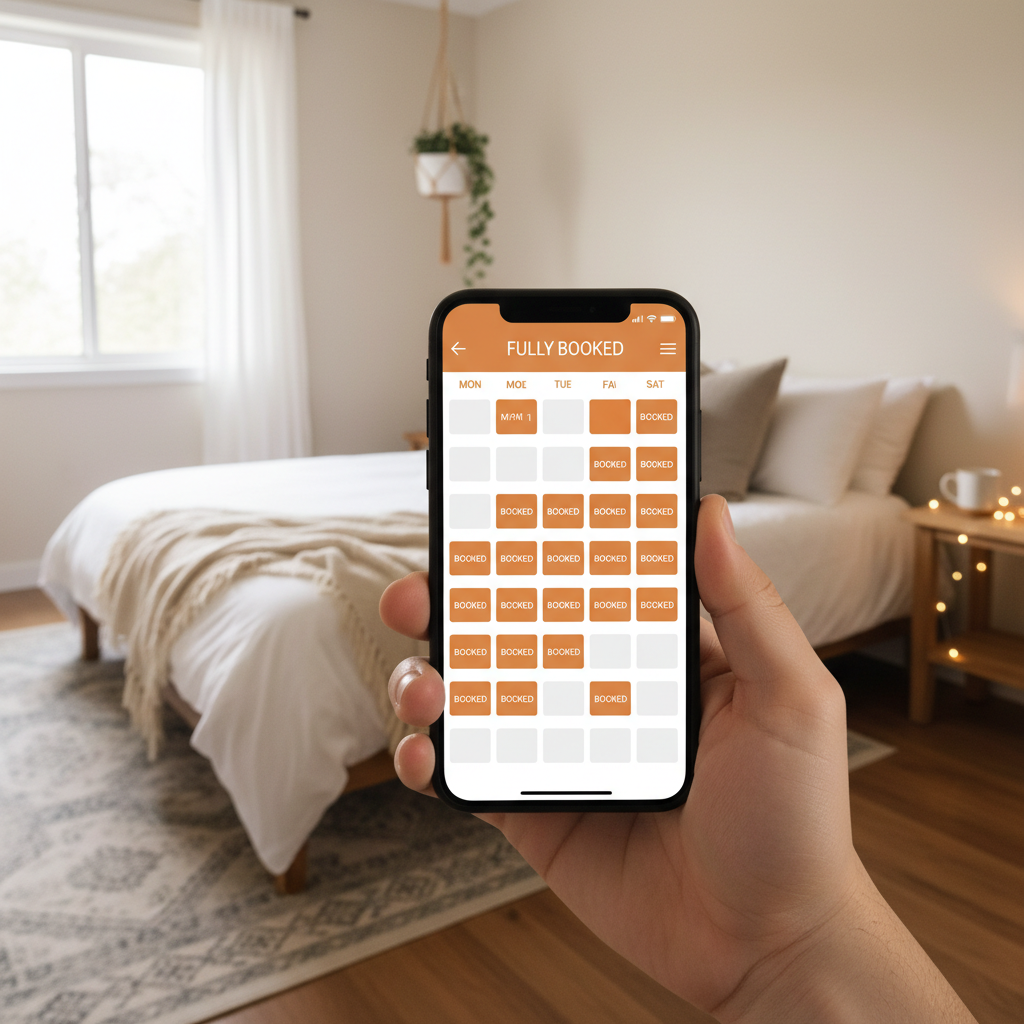
Every empty night is a perishable asset - once it's gone, you can never sell it again. For a 2-bed city-centre property earning £150 a night, slipping from 85% to 65% occupancy means more than £11,000 of lost revenue a year. The good news? Occupancy isn't luck. It's the output of a handful of repeatable decisions, and most self-managed hosts leave a surprising amount on the table. Here's the full playbook we use to keep our managed portfolio at 75-85% occupancy year-round.
The occupancy opportunity
Before the tactics, it helps to see the prize. The gap between an average listing and an optimised one is bigger than most landlords assume - and it compounds across the year.
Average annual occupancy: typical host vs optimised listing
Illustrative annual occupancy for a UK city-centre 2-bed. Moving from a static listing to the full playbook typically adds 20-25 percentage points - the difference between a property that covers the mortgage and one that pays you.
Those extra points aren't free, but they're cheap relative to the return. The levers below - guest targeting, listing quality, pricing, distribution, amenities, service and technology - each add a few points, and together they transform a calendar.
Know your ideal guest
Occupancy starts with knowing who you're trying to attract. A listing that tries to appeal to everyone appeals to no one in particular. Match your property, photos, description and pricing to one or two primary guest types and your conversion rate climbs sharply.
| Guest type | Books when | What they value most | Occupancy lever |
|---|---|---|---|
| Business travellers | Mon-Thu, often last-minute | Workspace, fast Wi-Fi, easy check-in, parking | Competitive weekday rates, corporate-ready setup |
| Leisure couples | Weekends and short breaks | Atmosphere, location, strong photos, high review scores | Romantic touches, walkability to attractions |
| Families | School holidays and half-terms | Cots, highchairs, space, safety, value | Welcome packs, family amenities, longer minimum stays |
| Event attendees | Concerts, fixtures, conferences | Proximity to venue, flexible dates, group space | Dynamic pricing to capture demand spikes |
| Relocation & mid-term | 1-4 week blocks, off-peak | Home comforts, kitchen, laundry, quiet | Weekly discounts that fill low-season gaps |
Once you've picked your target guest, audit every part of the listing through their eyes. A business traveller cares less about a king-size bed than a proper desk and a 100Mbps connection; a family of four scrolls straight past the cocktail glasses to check for a travel cot. Speak to your guest in the title, the first line of the description and the order of the photos.
Optimise your listing
Your listing is your shop window. The platform algorithm ranks listings by how well they convert and how often they're booked, so improving listing quality raises both your search position and your booking rate - a double win for occupancy.
The single biggest lever is photography. Professional photos consistently lift clicks and bookings by 30-50%. But it's not about the camera - it's about what you shoot.
Lead with the hero shot - the best-lit, most inviting photo goes first. It's the only image many guests see before deciding to click.
Shoot every room - guests want to see the whole space. Missing rooms raise suspicion and kill conversions.
Show, don't tell, the USPs - a balcony, free parking, a skyline view or a workspace all deserve their own photo.
Use natural light - shoot during the day, lights on, blinds open. Dark, flash-lit rooms look unappealing.
Refresh seasonally - a cosy autumn shot in October and a bright summer shot in May keep the listing feeling current.
Beyond imagery, every element of the listing should pull its weight:
| Listing element | What good looks like | Impact on bookings |
|---|---|---|
| Title | Front-loaded USPs: 'Modern 2Bed City Centre | Free Parking | Fast WiFi' | Up to 15% more clicks |
| Description | Specific, scannable, keyword-rich, sets accurate expectations | Higher conversion, fewer cancellations |
| Photos | Bright, professional, every room, hero shot first | +30-50% clicks and bookings |
| Reviews | 4.8+ average, recent, with replies to all | Top filter for most guests; drives ranking |
| Amenities list | Fully ticked - Wi-Fi, workspace, kitchen, parking, self-check-in | Appears in filters; missing means filtered out |
| Instant Book | Enabled, with sensible house rules | Captures impulse and last-minute demand |
Two underused tactics: keep your calendar genuinely open (guests filter out listings with blocked dates), and turn on Instant Book. Many hosts fear Instant Book, but with clear house rules and a few screening settings it captures the last-minute and impulse bookings that make up a big slice of high-occupancy calendars.
Strategic pricing
Static pricing is the single biggest occupancy killer. A nightly rate set once and left for months guarantees two things: you're too expensive in slow periods (empty nights) and too cheap in peak periods (money left on the table). Dynamic pricing - adjusting rates daily to demand - is how well-managed properties hit 75-85% occupancy without sacrificing revenue.
Dynamic pricing reads dozens of signals and moves your rate accordingly:
Local events - a Manchester United home game, an AO Arena sell-out or the Christmas Markets can triple demand for specific dates.
Season and day of week - weekends vs weekdays, summer vs winter, school holidays vs term time.
Competitor availability - when nearby comparable listings get booked up, your rates should rise.
Lead time - far-out dates priced for early birds; last-minute gaps dropped to fill them.
Booking pace - if a date is booking faster than usual, push the rate up; if it's lagging, nudge it down.
The effect on a single property is dramatic. Here's what dynamic pricing does to a Manchester 2-bed across a typical year:
Monthly occupancy: static pricing vs dynamic pricing
- Dynamic pricing occupancy %
Illustrative monthly occupancy for a Manchester 2-bed under dynamic pricing. Note the December lift (Christmas Markets) and the midweek smoothing that stops winter from collapsing - the period where static-priced properties sit half empty.
Practical pricing rules that move the needle:
Set a floor, not a ceiling - agree the minimum you'll ever accept, then let the algorithm push rates up in peak. Most hosts only think about ceilings and miss the upside.
Use minimum stays strategically - a 2-night minimum on weekends cuts one-night turnover and cleaning costs; relax to 1-night midweek to fill gaps.
Apply last-minute discounts - a date sitting empty 7 days out is worth less than a date filled at 20% off.
Charge for events, not just seasons - a £150/night property can legitimately be £400-£600 on a sold-out concert weekend. Most self-managers forget and leave it at £150.
Review weekly - pricing rules need a human eye. A pure algorithm occasionally does something silly; a weekly check catches it.
Multi-platform distribution
If you're only on Airbnb, you're only reaching a slice of the market. Every platform has a different audience and a different demand pattern, and listing across all of them is one of the highest-impact, lowest-effort occupancy moves available.
| Platform | Audience strength | Best for filling |
|---|---|---|
| Airbnb | Largest leisure audience, strong reviews | Weekends, couples, tourists |
| Booking.com | Huge reach, business and leisure | International guests, mid-week, last-minute |
| Vrbo | Whole-home, family focus | Family groups, longer stays |
| Expedia group | Package and travel-agent traffic | International and inbound travellers |
| Channel manager (16+ sites) | One calendar, no double-bookings | Synchronising everything above |
The catch is calendar sync. Listing on five platforms with five separate calendars is a recipe for double bookings. A channel manager - software that syncs availability and pricing across every platform from one place - is essential once you list on more than one site. It's the infrastructure that turns multi-platform from a risk into pure upside, typically adding 15-25% to annual bookings.
Appealing amenities
Amenities do double duty: they win bookings (guests filter by them) and they win reviews (guests remember them). The most impactful amenities aren't the expensive ones - they're the thoughtful ones.
| Amenity | Cost to add | Why it fills nights |
|---|---|---|
| Fast Wi-Fi (100Mbps+) | Low | Non-negotiable for business and leisure guests; a top search filter |
| Dedicated workspace | Low | Unlocks the entire remote-work and business market |
| Self-check-in (lockbox/smart lock) | Low-medium | Captures late arrivals and removes check-in friction |
| Free parking | Varies | Massive differentiator in city centres; huge for weekend guests |
| Fully equipped kitchen | Low | Longer stays, families, savings on eating out |
| Tea, coffee & welcome basket | Tiny | Creates a 'wow' first impression and 5-star reviews |
| Travel cot & highchair | Low | Removes a major barrier for families - they won't book without them |
| Pet-friendly | Low | Opens an underserved market with less competition and higher rates |
| Smart TV with streaming | Medium | Expected for leisure stays; extends evenings |
| Noise monitor (privacy-safe) | Medium | Protects against parties and keeps neighbours happy long-term |
The pattern: the cheap, thoughtful amenities drive reviews, reviews drive ranking, and ranking drives occupancy. A £5 welcome basket is worth more than a £500 sofa in occupancy terms.
Exceptional guest service & reviews
Reviews are the flywheel behind occupancy. A 4.9-rated listing ranks higher, converts better and can charge more than a 4.6-rated one - and the difference compounds. Guest service is how you manufacture those reviews.
Respond within an hour - Airbnb's algorithm rewards fast responses with better placement. Slow responders sink.
Send a pre-arrival message - a warm message 3-5 days out with check-in details sets the tone and cuts no-shows.
Be reachable in-stay - a quick reply to 'how does the heating work?' turns a potential 3-star into a 5-star.
Ask for the review - most happy guests don't review unless asked. A gentle nudge after check-out lifts your review rate dramatically.
Respond to every review - good and bad. It signals an active, caring host to future guests and to the algorithm.
"We went from 68% to 84% occupancy in one quarter just by replying faster, adding a welcome basket and chasing reviews. Same property, same photos - the reviews did the heavy lifting."
- Tom H, landlord who self-managed then switched to Truestays
Handle the bad reviews too. A calm, professional public reply to a 3-star review reassures future guests more than a string of unchallenged 5-stars. The goal isn't zero negative reviews - it's a high average and visible, responsive ownership.
Embrace technology
The right tech stack removes the operational friction that usually caps self-managed occupancy. You can't fill a calendar if you're too busy answering the same message five times.
Property management software - one dashboard for bookings, messages, pricing and housekeeping across every platform.
Automated messaging - templated replies for enquiries, confirmations, check-in instructions and review requests, triggered automatically.
Smart locks / keyless entry - self-check-in captures late flights and last-minute arrivals and removes the 'what time can I arrive?' bottleneck.
Dynamic pricing tool - reads demand signals and adjusts nightly rates daily, the engine behind most of the gains above.
Noise and occupancy monitors - privacy-safe sensors that deter parties and protect your listing (and your neighbours) long-term.
Think outside the box
When the calendar has stubborn gaps - typically midweek off-peak and deep-winter weeks - the standard levers run out of steam. That's when creative distribution fills the gaps your competitors leave open.
Target the work-from-anywhere crowd - a 2-4 week stay for a remote worker fills a quiet month in one booking. Offer weekly discounts and a proper workspace.
Court corporate mid-week blocks - businesses relocating staff or running training need Mon-Thu stays. A corporate-ready listing wins repeat, predictable business.
Bundle with local attractions - partner with a nearby restaurant, spa or attraction for a 'weekend getaway' package that lifts your listing above the noise.
Run off-peak promotions - a Sunday-night-free-with-a-Friday-booking deal fills the gap night that ruins weekend occupancy for most hosts.
The hosts who win in February aren't the ones with the prettiest listing - they're the ones who actively went looking for guests the platform wouldn't deliver on its own.
Your quick-wins checklist
Not sure where to start? These are the changes that move occupancy fastest, roughly in order of effort-to-reward:
Turn on Instant Book with sensible house rules
Refresh your lead photo and shoot any missing rooms
Fully complete the amenities list - tick every box that applies
Set a pricing floor and switch on dynamic pricing
List on at least Airbnb, Booking.com and Vrbo via a channel manager
Add a welcome basket, fast Wi-Fi and self-check-in
Reply to every message within an hour
Send a pre-arrival message and a post-stay review request
Respond to every review - good and bad
Review pricing weekly and chase the empty dates first
Key takeaways
Occupancy is engineered, not luck - a handful of repeatable levers move it 20-25 percentage points
Dynamic pricing is the biggest single driver; static pricing is the biggest single killer
Multi-platform distribution via a channel manager adds 15-25% to annual bookings
Professional photos lift clicks and bookings 30-50% - the highest-ROI listing investment
Cheap, thoughtful amenities drive reviews, and reviews drive ranking and occupancy
Respond fast, ask for reviews, and reply to every one - the algorithm rewards it
Creative distribution (remote workers, corporate mid-week, off-peak bundles) fills the gaps platforms won't
A well-run property should sit at 75-85% occupancy year-round - if yours doesn't, the levers above are why
Ready to get started?
Get a free personalised income estimate for your property. No commitment, no pressure.